Welcome to the NWIPC - Northwest Invasive Plant Council

What are invasive plants and why are they a problem?

Invasive plants are species that are able to quickly establish and flourish in new areas due to a competitive ability over other vegetation. Invasive plants are non-native and can quickly form extensive and dense infestations. Infestations in the natural environment can threaten biodiversity, reduce forage for wildlife and reduce habitat for rare or endangered species. Certain invasive plants also have undesirable traits such as toxicity to animals and humans or they can restrict recreation due to forming extremely dense infestations or containing spines. When invasive plants infest agricultural areas, they can reduce forage for livestock, contaminate seed stocks and reduce crop yields. Some invasive plants are known to affect regeneration of tree seedlings in the forest industry.


Name: Spotted knapweed
The "spotted" appearance of spotted knapweed is a result of black-tipped bracts on the flowerheads. Flowers are usually purple, but sometimes white, and found ...
Learn More

Name: Hound’s-tongue
Hound's-tongue was given its name because its rosette leaves (leaves produced in the first year) resemble dog's tongues. Hound’s-tongue is a biennial or sh ...
Learn More

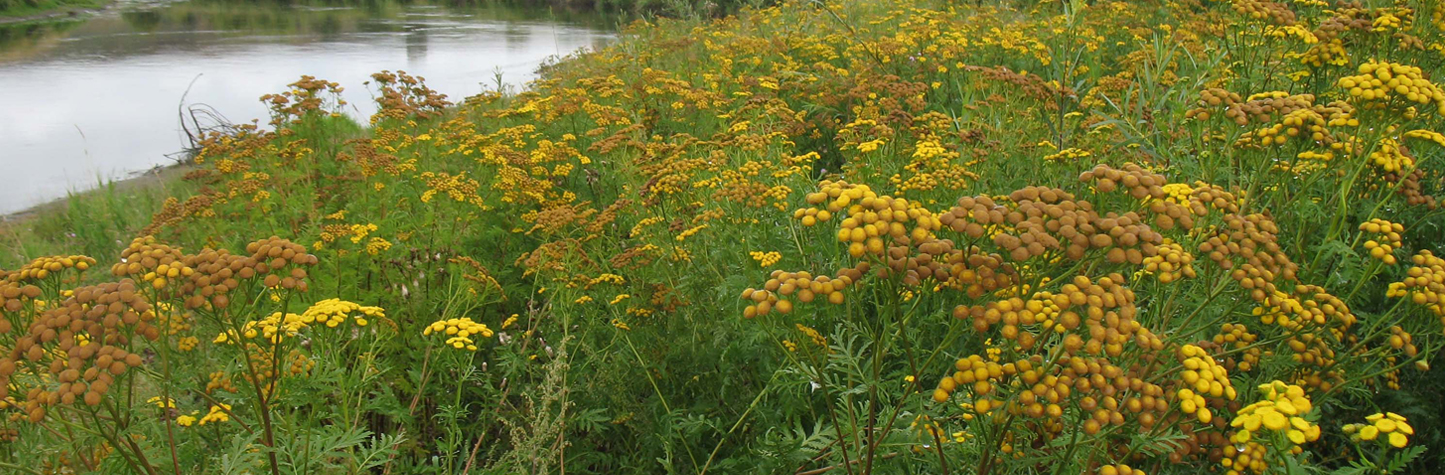
Name: Common tansy
Common tansy is a perennial flowering plant with small, yellow button-like flowers arranged in clusters. The leaves are dark green and resemble ferns. Stems m ...
Learn More

Name: Marsh plume thistle
Marsh plume thistle is a tall thistle (up to 2 m tall) usually consisting of a single unbranched stem. The flowers are purple and found at the top of the plant ...
Learn More

Name: Leafy spurge
Leafy spurge is a perennial plant with yellowish-green flowers surrounded by distinctive heart-shaped bracts. Leaves are narrow and arranged in a spiral format ...
Learn More

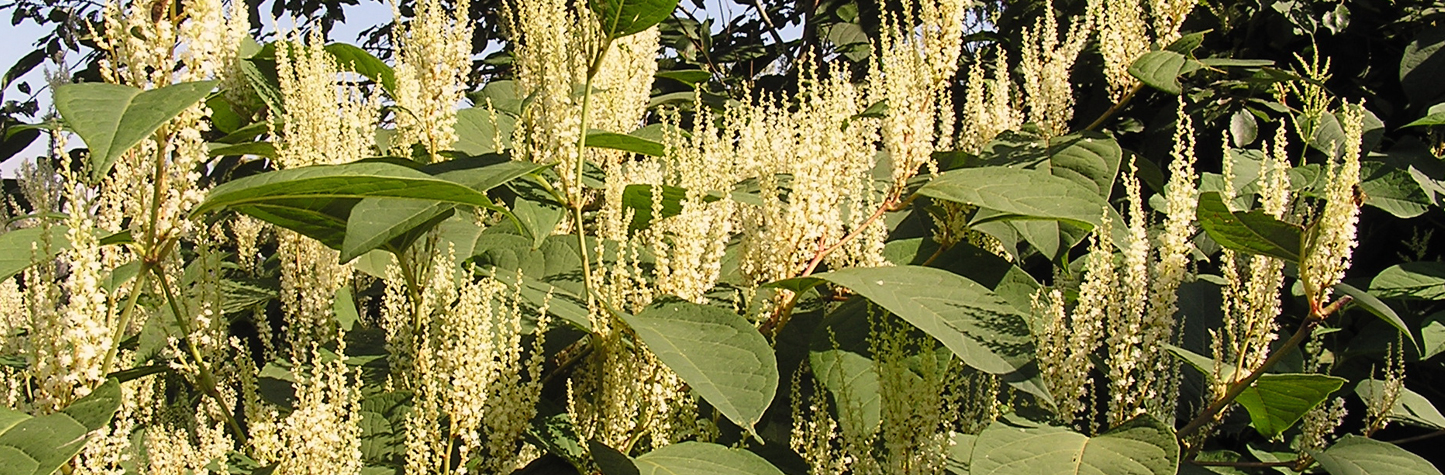
Name: Giant and Japanese knotweeds
Japanese Knotweed is a perennial herb with round and hollow (bamboo-like) stems and wide leaves pointed at the tip. Leaves are darker green above and lighter g ...
Learn More

Name: Orange hawkweed
Orange hawkweed is a perennial species identified by its bright orange to orange/red flowers assembled in clusters atop leafless stems. Stems are hairy and cont ...
Learn More

Name: Field scabious
The flowers of field scabious are violet-blue in colour and are similar in shape to red clover flowers. Stems and leaves are covered in stiff hairs. Leaves ar ...
Learn More

Name: Yellow hawkweeds
Yellow hawkweeds are similar to orange hawkweed but have yellow flowers. There are both native and non-native yellow hawkweeds in BC.
Learn More

Name: Scentless chamomile
Scentless chamomile has daisy-like flowers, nearly fern-like leaves and grows to 1 m in height. It is distinguished from oxeye daisy by its small flowers, only ...
Learn More

Name: Scotch broom
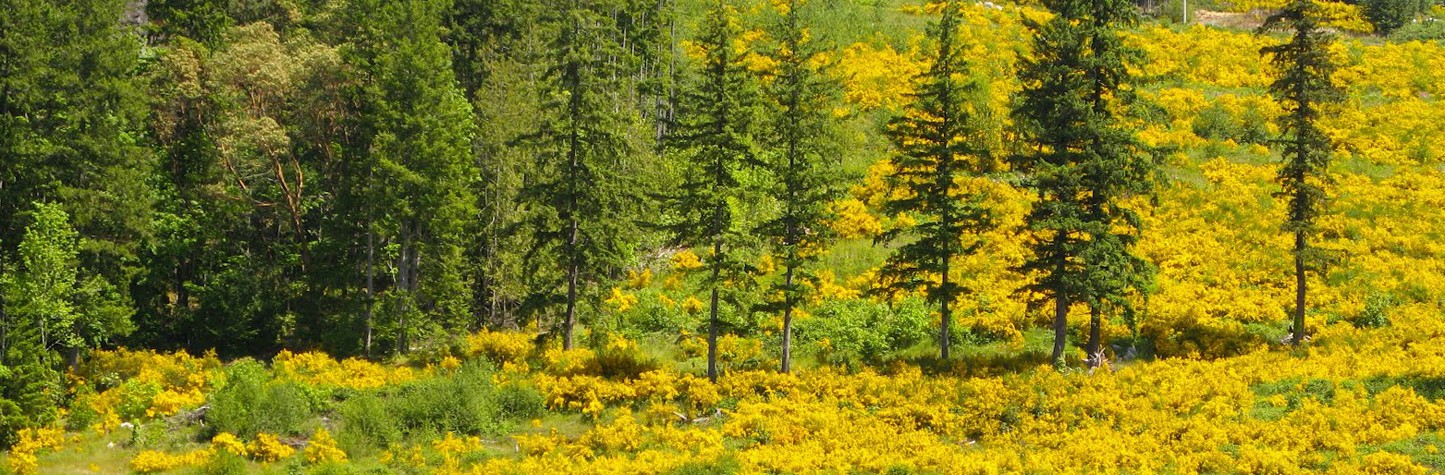
Scotch broom is an evergreen shrub up to 3 m in height. Stems are woody and generally five-angled. Pea-like flowers are found along the stems and are yellow ...
Learn More

Name: Diffuse knapweed
Diffuse knapweed has sharp spines on the flowerhead bracts and usually has white flowers. Flowers can also be purple. It is a biennial or short-lived perennia ...
Learn More

What can we do?

Prevention of infestations is the most successful and cost-efficient method of dealing with invasive plants. Elimination may be possible for established infestations if the area is not too large and re-infestation by neighbouring plants is not likely. In some instances, infestations are too large to be practical for elimination, but must be controlled to prevent spread and new infestations. Control or elimination efforts generally have three options: mechanical, chemical or biocontrol methods.

Usually the most successful control or elimination efforts use some form of ‘Integrated Pest Management.’ Integrated Pest Management is a management strategy that identifies a number of steps used to control invasive plants, including:

What You Can Do provides specific actions we all can take to prevent and control invasive plant infestations.

Weeds know no boundaries: join forces!

The Northwest Invasive Plant Council (NWIPC) developed as a committee in 1992 and a not-for-profit organization in 2004 with the goal of preventing further damage to the ecosystems of the northwest and central BC from invasive alien plants. Bylaws and a constitution govern the NWIPC, and documents such as the current NWIPC 2007 Plan and Profile, and Invasive Plant Strategy for BC detail the strategies used by the NWIPC to manage invasive plants. Please contact us with any concerns or questions.


August 1st, 2008
Come check us out at events across Northern BC
Dear NWIPC Members, The NWIPC info booth will be out at various events across northern BC. See...

June 11th, 2008
Events this June and July
June 12th - 15th: -Seafest - Prince Rupert 14th: -Farmers Market - Terrace 15th: -A Walk in the...

June 11th, 2008
NWIPC NEWS Volume 8
Here's the Scoop. Click the link to read it. This pdf is full of interesting and inspiring info...

April 22nd, 2008
NWIPC 2007 Annual Report
The NWIPC annunal report for 2007 is now available for downloading from our site...

November 1st, 2007
Let the Bugs Do the Work
The NWIPC is always looking for new and better ways to eliminate invasive plants. One interesting...

October 1st, 2007
Interview with Becky Brown on the Corrections Crew Field Days
Corrections Crews are made up of inmates participating in the treatment of invasive plants. Heading...

September 1st, 2007
Interview with MOT's Ryan Spillett
The NWIPC would not be as effective without our partners. They give us the funds, the knowledge...

View all Recent News

Newsletters

Meet our Partners and Sponsors!

How do you say it? Invasive Plant versus Noxious Weed

Report Weeds

Funktion Communications - Website Design Nelson BC